Digital nomad residency in Spain: up to three years
18 November 2026
The initial international remote worker permit can be granted for up to three years. Who applies for it, what documents are required, and how 200% of the minimum wage is calculated.
If you are interested in digital nomad residency in Spain, the initial authorization for international remote workers can be granted for a maximum of three years.
This article summarizes who can apply for it, what documents are required, and how income is proven. This is the initial application, not a separate visa.
The initial authorization can last up to three years. It is not a one-year permit that needs to be renewed right away: the maximum duration of this first grant is three years.
Regulations
Law 14/2013, of September 27, on support for entrepreneurs and their internationalization.
Joint instruction from the Director General for Spaniards Abroad and Consular Affairs and the Director General for Immigration on the practical application of this law to visas and residence permits for international remote work.
Organic Law 4/2000, of January 11, on the rights and freedoms of foreigners in Spain and their social integration.
Who is submitting the application?
The initial application is submitted by:
Those who are legally in Spain, or those who entered with the visa under Article 74 quater of Law 14/2013 (Article 74 quinquies.1).
Anyone who already has an international remote work visa and wants to continue residing in Spain. The application must be submitted within sixty calendar days before the visa expires (Article 74 quater.3).
Anyone who already has a permit and needs to report a change that affects its conditions, within thirty days of the change occurring (seventh additional provision).
If the person is in Spain, they can appoint a lawyer licensed in Spain to represent them. At Asesoría Para Inmigrantes Abogados, the application is submitted online on your behalf.
Documentation
It is advisable to read the instructions on the form itself. These are the documents for the initial application:
Form, representation, and passport
MIT form, completed and signed by the teleworker.
If a representative is submitting the application, the power of attorney that allows them to sign the application and provide the documentation on behalf of the applicant.
Legible copy of the complete passport, or of the valid travel document: all pages (Articles 62.3.a and 74 quinquies.1).
Proof of payment of the fee, Form 790, code 038. If the payment is not indicated on the form itself, proof of payment must be attached (Article 62.3.g).
Three months with the foreign company
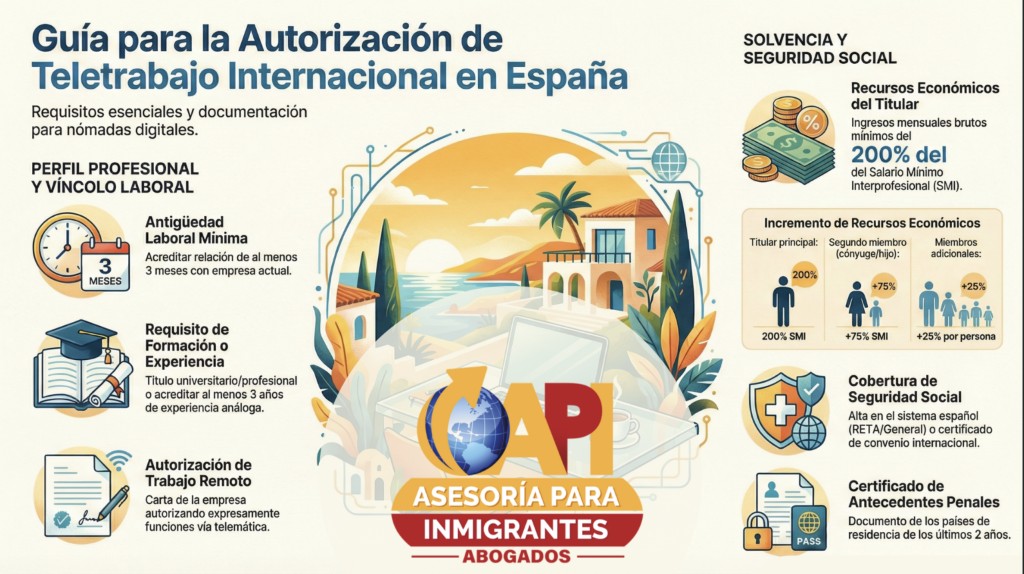
An employment or professional relationship of at least three months, as of the date of the application, with the foreign company or companies must be proven. This is proven with the employment or professional contract (Article 74 ter, letters c and d).
These three months are not required if the person already has a prior initial authorization, such as in a modification of the conditions, or a teleworker visa: in that case, the relationship has already been proven.
A previous employment relationship does not serve to prove a professional relationship, nor vice versa.
If you are a self-employed business owner and are the sole owner of your company, or if you have effective control without being the sole owner, your length of service is assumed by proving 100% ownership and actual, continuous activity of that company for more than one year.
The company has been in operation for at least one year
Proof must be provided that the foreign company, or the group, has been engaged in real and continuous activity for at least one year. The official certificate from the commercial registry, or the equivalent from the country of origin, is sufficient (Article 74 ter, letter a).
If the applicant is a self-employed company director, sole proprietor or person with effective control, please add:
Proof of ownership or effective control.
Company's most recent corporate income tax return.
Proof of investments in means of production.
Report from the Social Security agency of the country of origin, or similar, with the history of employees registered by the company.
Financial resources
Article 62.3.f of Law 14/2013 calls for compensation for the policyholder and his/her family. The amounts are gross, before taxes, Social Security, or other withholdings:
Who | Gross monthly amount |
|---|---|
Beneficiary | 200% of the current national minimum wage (SMI). |
Second person (the holder and a family member) | An additional 75% of the SMI. It does not replace 200% of the policyholder's amount. |
Each additional member | An additional 25% of the SMI. |
To prove this income:
Pay stubs or invoices from the three months prior to the application, depending on whether the contract is for employment or professional services.
Bank statement in the name of the holder, stamped or signed by the bank, for those same three months. It must match the pay stubs or invoices. The transactions that prove payment are marked separately from the rest.
If this income does not reach the minimum, up-to-date bank certificates from Spanish or foreign banks, in the name of the holder and stamped or signed, which cover the difference with savings or other liquid income for the entire term of the authorization.
In the case of self-employed individuals operating as companies, if these documents are not available, the personal income tax return of the individual for the year prior to the application, equivalent to the IRPF (personal income tax).
Letter from the company and job description
Letter from the foreign company authorizing work from Spain. It must indicate the job profile, the main duties, that the work can be done remotely, the salary in euros, and the other conditions of remote work (Article 74 ter, subparagraphs b, c, and d).
For self-employed company directors, authorization for remote work is implicit, but the letter must contain the rest of this information.
Résumé, with a simple translation if it is not in Spanish.
Copy of the qualification related to the position: undergraduate or graduate degree from a university, vocational training program, or a prestigious business school. Failing that, at least three years of experience in similar roles (Article 74 bis.2).
If the profession is regulated, recognition of the Spanish qualification or a sworn affidavit before a notary public stating that the profession will not be practiced in Spain is required.
To equate experience with higher education, one of these documents is required:
Employment history, or the equivalent from the country of origin, which matches the companies' certificates. These certificates indicate the start and end dates, the duties in sufficient detail, and the current registration in that country's system.
Certificate of professional competence from the authority of the country of origin. If it does not exist there, or if obtaining it is very burdensome due to the timeframes, the company's letters must detail the functions and tasks typical of a person with level 1 or 2 training under the Spanish Qualifications Framework for Education, as applicable.
Social Security
The scheme depends on the type of relationship with the company (Article 62.5). Employees are covered by the General System. Self-employed workers are covered by the Special Regime for Self-Employed Workers (RETA).
Employed: Registration of the foreign company with the Social Security system, without workplaces in Spain, and commitment to register the teleworker in the General Regime once the authorization is obtained and before starting work in Spain.
Professional relationship: Commitment to register with the RETA (Special System for Self-Employed Workers) once the authorization has been obtained and before starting the activity.
Registration requires the payment of contributions. Failure to comply with this condition may result in the termination of the authorization.
Anyone who wishes to remain in the Social Security system of their country, to the extent and for the period allowed by the applicable bilateral or multilateral agreement or international instrument, must provide the certificate of applicable legislation. This certificate is issued by the Social Security agency in the home country and must explicitly state that it covers the posting to work remotely from Spain. Mere applications for this certificate are not valid.
This certificate exempts the holder from registering with the Spanish Social Security system. If the agreement does not cover Spanish public health care, proof of health insurance for that contingency must be provided.
Background and insurance
Criminal record certificate from the country or countries where you have resided for the past two years. This is not necessary if you already have a residence or stay permit in Spain for more than six months and that certificate was provided to obtain it (Article 62.3.c).
Affidavit stating that you have no criminal record in the countries where you have resided for the past five years (Article 62.3.c).
Public or private health insurance (Article 62.3.e).
If an international Social Security coordination regulation covers health care, the certificate of entitlement from the institution of that State must be provided. If the regulation does not cover it, the public or private insurance must provide coverage comparable to that of the National Health System.
Insurance is not required when, once the authorization has been granted, the person is going to enroll in Social Security in Spain.
Travel insurance, insurance that only reimburses medical expenses, insurance with co-payments, and insurance with a waiting period are not accepted.
Translation, apostille and explanatory statement
It is advisable to attach a letter explaining the documentation, especially when it does not exactly match what was requested. This makes the work of the person processing the file easier.
Public documents that are not in Spanish must be accompanied by a translation from a sworn translator-interpreter authorized by the Ministry of Foreign Affairs, European Union and Cooperation.
Failing this, only translations made or reviewed by Spanish diplomatic missions or consular offices abroad, with a certification stamp or a signed translation and then legalized at the Legalization Section of the Ministry, or by the diplomatic missions or consular offices of the document's country of origin in Spain, apostilled or legalized by that same section, are valid.
For the rest of the documentation, it is sufficient for it to be translated by a sworn translator-interpreter.
Public documents from a foreign authority must be submitted legalized or apostilled.
Additional documents may be requested at any time if those submitted are not sufficient to prove compliance with the requirements of Law 14/2013.
The guide, in an outline
If you want the firm to submit it
If you are already legally in Spain, the application can be made online with representation. Message us on WhatsApp, call +34 911 177 706 or submit your case here.
This article provides general information about immigration and nationality, not legal advice about your specific case. For a personalized assessment, write to us.
Attorney Milagros Mena M.
Lawyer in Venezuela. Bar Association No.: 135.230. Attorney in Spain. Málaga Bar Association No.: 10,819. Specialist in Immigration, Foreign Nationals and Asylum Law. WhatsApp: +34 665 765 178.